My guess
"Mars gets about 4 hours of daylight."
The truth
A Mars day is 24 h 39 m. The Sun is up for about 12 hours, just like on Earth.
Geometry in the World · Midterm Project
24 hours on Earth. Under 10 on Jupiter. 117 Earth days on Venus, where the Sun rises in the west. Why so different? The answer is geometry: a spin, an orbit and a tilt.
by Elchibek Dastanov · Fall 2026
Notice + Name
This is a real sunset on Mars, photographed by NASA's Curiosity rover. It looks like an evening on Earth. So I asked: how long is a day on Mars?
I guessed about 4 hours of daylight. I was wrong, and the real answers for the other planets surprised me even more.
A day feels like a fixed fact. But it is really geometry: a spinning ball turning until it faces the Sun again.
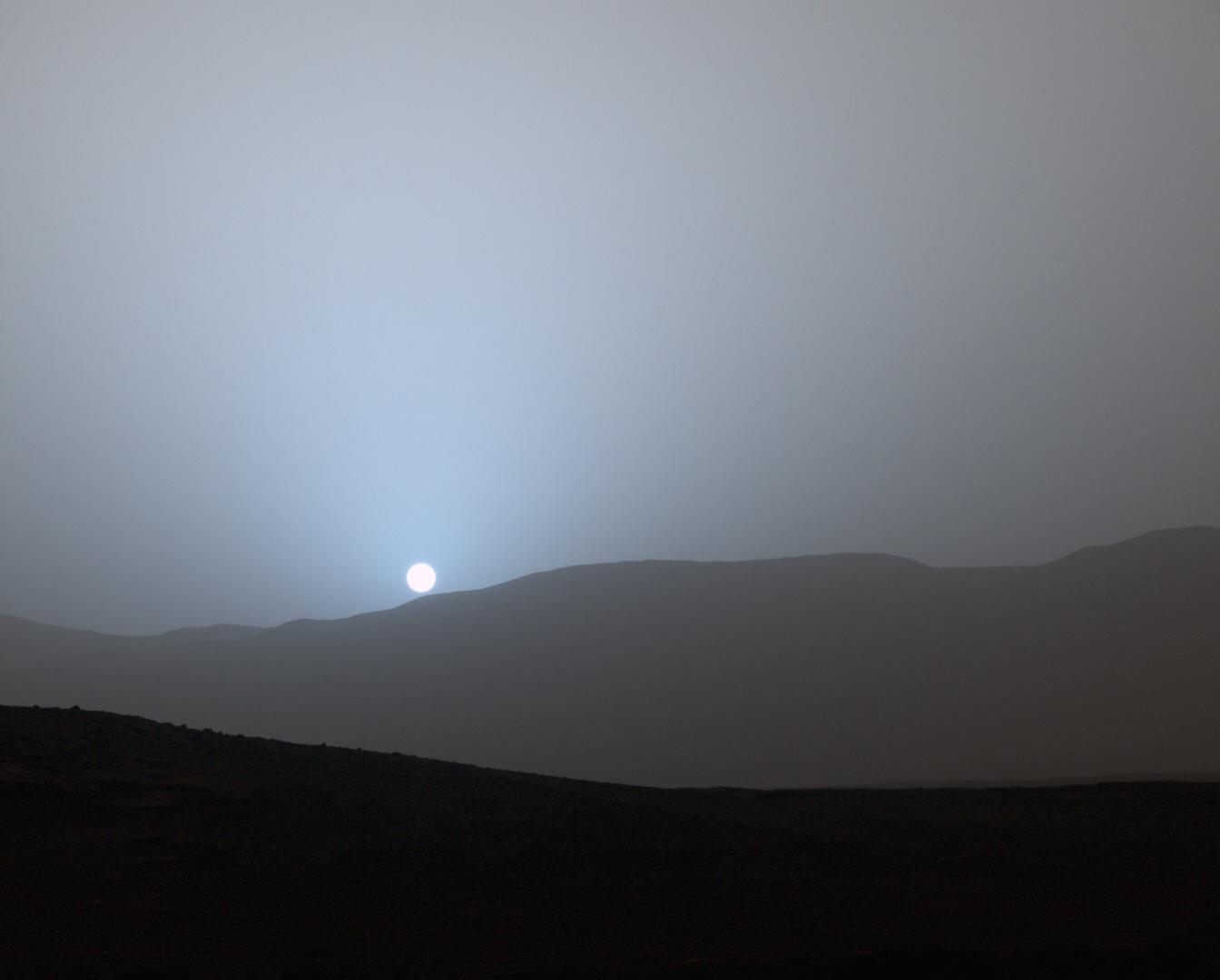
My guess
"Mars gets about 4 hours of daylight."
The truth
A Mars day is 24 h 39 m. The Sun is up for about 12 hours, just like on Earth.
My guess
"Bigger planets spin slower."
The truth
Jupiter, the biggest planet, has the shortest day: 9 h 56 m.
My guess
"A day is one spin."
The truth
Earth spins once in 23 h 56 m, but a day is 24 h. Where do the extra 4 minutes come from?
How far the planet has turned. One full spin = 360°.
How far it has moved around the Sun. One year = 360°.
How far the spin axis leans. Earth: 23.4°. Uranus: 98°, almost on its side.
My two questions
A tour of eight worlds
Scroll to fly past every planet. Each one has its real tilt and spins at its true relative speed (one Earth spin = 10 seconds). Sunlight comes from the left, so you can see day and night.
Explain the mathematics
Follow one person standing on a planet at noon. Scroll slowly: the picture moves with you.
The Sun is straight overhead. The blue line points from the planet's center, through our person, to the Sun.
The planet turns once (on Earth: 23 h 56 m). But it also moved along its orbit, so the Sun is not overhead yet.
The person's line is parallel to the start line: both point at the same faraway star. The line to the Sun crosses both, so the two θ angles are alternate angles, and alternate angles are equal.
Turning the extra θ brings noon back. So one day = 360° + θ.
θ = 360° ÷ 365.26 days ≈ 0.986°. Turning that extra bit takes 3 min 56 s, and 23 h 56 m 4 s + 3 m 56 s = 24 h.
Venus spins against its orbit, so it needs only 360° − θ. That's why its day (117 Earth days) is shorter than its spin (243).
In one day T, the planet moves around the Sun by θ and spins by 360° + θ:
Put them together and divide by 360° · T:
For a backwards spin (360° − θ), the minus becomes a plus.
Mercury's strange day, solved
Mercury spins exactly 3 times every 2 orbits, so Tspin = ⅔ of a year. The rule gives:
One day on Mercury lasts two of its years.
Sunlight always lights exactly half of a planet. As the planet spins, you ride around your circle of latitude. The part of that circle in sunlight is the part of the day you get light:
No tilt: every circle is cut exactly in half, so everyone gets half a day of light (12 h on Earth), all year. With tilt: one half of the planet leans toward the Sun. Its circles are more than half lit (summer), the other half's less (winter). Near the poles a circle can be all lit (midnight sun) or all dark.
Checking my model: it predicts 14 h 37 m of daylight in San Francisco in June. The real number is 14 h 47 m. The 10 minutes come from Earth's air bending sunlight, which pure geometry leaves out.
Mars missions
Rover teams have lived on Mars time, starting work 40 minutes later every day. Future astronauts will need clocks built on a 24 h 39 m day.
Solar energy
Hours of daylight decide how much power a solar panel makes, on Earth and on Mars. The tilt geometry predicts them for any place and season.
Life in the Arctic
In Utqiaġvik, Alaska, the Sun does not rise for about 65 days each winter. That's the tilt geometry at work, and people plan their lives around it.
Create
I turned the daylight geometry into art. Each mandala shows one planet's whole year of sunlight in a single circle. Every pixel is calculated.
What my art showed me: Earth, Mars, Saturn and Neptune draw almost the same mandala because their tilts are almost the same. Size, distance and day length don't change the shape. Only tilt does.
Seasons repeat, so 360° around the mandala = 360° around the Sun.
The equator and the two equinoxes are always rose (12 h of light in 24 h): a built-in check that my math is right.
Half a year later every place gets the opposite: 70% daylight in June means 30% in December.
Pick a spin, a year and a tilt. The rule from 2.2 computes the day, and the mandala draws your planet's year of sunlight.
What I hope you notice, and wonder
Notice that Earth and Mars draw nearly the same mandala. They are "tilt twins", so Mars has seasons like ours.
Wonder what life would be like on Uranus, where the Sun can stay up for 42 years and then disappear for 42 more.
Mathematical mindset
A wrong guess started it
My "4 hours on Mars" guess made me compare Earth's spin (23 h 56 m) with its day (24 h). That small gap became this whole project.
I tested my model
My geometry is 10 minutes off in San Francisco because it leaves out the air. Knowing what a model ignores is part of the math.
Science keeps updating
Saturn's day was corrected in 2019 and Uranus's in 2025. Many tables still print the old numbers; I used the newest ones.
What I still wonder
Some planets spin exactly once per orbit. Then 1/Tspin − 1/Tyear = 0, and the day lasts forever: one side always day, the other always night. Could anything live on the line between them?